You've felt it before: a sudden panic that doesn't match your circumstance. A deep aversion to something that triggered a disproportionate response. A pattern of anxiety or avoidance that your therapist says doesn't fit your personal history. You've never been through what your parent went through, never witnessed what your grandparent witnessed, yet their ghosts somehow live in your nervous system.
Mark Wolynn's It Didn't Start with You: How Inherited Family Trauma Shapes Who We Are and How to End the Cycle offers a framework for understanding this seemingly inexplicable inheritance. It's not metaphorical. It's biological. Parents' and grandparents' traumatic experiences leave actual molecular marks on the genes their children inherit—marks that can alter how a child's nervous system responds to stress, threat, and safety. This is the emerging science of intergenerational epigenetic inheritance, and it changes how we understand the origins of our own suffering.
The Big Idea: Trauma Can Travel Through Generations
For decades, we understood trauma transmission in behavioral terms. A parent who was abused might recreate similar dynamics with their child. A parent with PTSD might hypervigilance their children, teaching them the world is dangerous. These are real, important transmission mechanisms. But they're not the only ones.
Wolynn synthesizes research from neuroscience, epigenetics, and family systems therapy to argue something more radical: when a person experiences severe trauma, the stress response system—the amygdala, the hypothalamic-pituitary-adrenal (HPA) axis, the genes that regulate cortisol—becomes altered at the molecular level. These changes can be biologically transmitted to the next generation, and even the generation after that. Your unexplained anxiety, your hair-trigger startle response, your depression that doesn't respond like the textbooks say it should—these might not originate in your own experience. They might be echoes of your family's history written into your epigenome.
The book's central premise is powerful: many of the persistent patterns you struggle with—the ones that feel like "just how I am"—may originate from traumas in your family history that you never directly experienced. And if that's true, it changes the whole approach to healing. You're not trying to fix a defect in yourself. You're trying to break a cycle.
How Trauma Gets "Under the Skin": The Epigenetics
DNA methylation is the mechanism. It's a process where chemical tags—methyl groups—attach to sections of DNA. These tags don't change the DNA sequence itself. They change how the gene is expressed. Think of it like volume control: a gene can be turned up loud, left at normal volume, or turned down to a whisper. Methylation tags help determine that volume without rewriting the music itself.
When severe stress or trauma occurs, the body's stress-response system activates intensely. The amygdala fires, the HPA axis floods the system with cortisol, the nervous system shifts into survival mode. If this activation is prolonged or repeated—as in childhood abuse, war, displacement, loss—the body adapts. One of the ways it adapts is through epigenetic modification of genes that regulate the stress response.
Two genes are critical here: NR3C1 (the glucocorticoid receptor gene) and FKBP5 (FK506-binding protein 5). Both regulate the HPA axis—the body's central stress-response system. When these genes are epigenetically altered—when they are methylated—the glucocorticoid receptor's expression decreases. This means the body becomes less able to turn off cortisol signaling when stress passes. The person becomes stuck in a state of elevated threat-sensitivity. Their nervous system is tuned to detect danger even when there is none.
And here's the part that changed our understanding of inheritance: these epigenetic marks can be passed to the next generation. A parent whose NR3C1 gene was methylated by their own trauma can pass an altered version to their child—not a changed DNA sequence, but a changed pattern of how that gene is expressed. The child's stress-response system comes online pre-tuned toward vigilance. The child can develop anxiety, depression, PTSD vulnerability, or a flattened stress response without ever having experienced the original trauma.
What the Research Shows: Key Studies
In 2016, Rachel Yehuda and colleagues published a study that became the foundation of the intergenerational epigenetics field. They studied 32 Holocaust survivors, 22 of their offspring, and controls. What they found was striking: both survivors and their offspring showed epigenetic changes at the FKBP5 gene—but in opposite directions. Survivors had higher methylation of FKBP5; their children had lower methylation. This opposite pattern suggests a biological response to parental trauma exposure. The study was the first demonstration of preconception stress effects on epigenetics in parent-offspring pairs in humans. It opened the door to understanding how trauma doesn't just hurt people—it marks the biology they pass on.
Yehuda, R., Daskalakis, N. P., Bierer, L. M., et al. (2016). Holocaust Exposure Induced Intergenerational Effects on FKBP5 Methylation. Biological Psychiatry, 80(5), 372–380.
A 2018 systematic review by Watkeys and colleagues examined studies across multiple populations and found a consistent pattern: NR3C1 promoter methylation is associated with childhood maltreatment. The mechanism is clear: increased methylation leads to reduced glucocorticoid receptor expression, which impairs cortisol feedback inhibition. The result is heightened vulnerability to stress. Crucially, the research showed that even harsh (non-abusive) parenting affects offspring NR3C1 methylation. The epigenetic marks aren't just a response to extreme trauma—they're shaped by the quality of relational experience itself.
Watkeys, O. J., Queue, E., & Fedor, A. (2018). Glucocorticoid receptor gene (NR3C1) DNA methylation in association with trauma, psychopathology, transcript expression, or genotypic variation: A systematic review. Neuroscience & Biobehavioral Reviews, 90, 313–329.
A 2025 study published in Nature Scientific Reports studied 48 families (n=131 individuals) across three generations of Syrian refugees. The researchers identified 14 differentially methylated positions associated with germline (inherited) exposure and 21 with direct exposure to violence. This was the first report of an intergenerational epigenetic signature of violence spanning three generations. It's crucial evidence that intergenerational epigenetic effects are not limited to one generation—the mark can travel across time, shaping the nervous systems of grandchildren of trauma survivors.
Epigenetic signatures of intergenerational exposure to violence in three generations of Syrian refugees. Scientific Reports (2025).
A 2025 systematic review in BMC Psychology examined 18 quantitative studies on the impact of trauma-focused psychotherapy on intergenerational trauma outcomes. The hopeful finding: trauma-focused therapies—including Trauma-Focused Cognitive Behavioral Therapy (TF-CBT) and Eye Movement Desensitization and Reprocessing (EMDR)—showed promise in normalizing stress hormone levels and modulating epigenetic markers. This suggests that the changes wrought by trauma are not permanent or immutable. The cycle can be broken—not just behaviorally, but at the molecular level. Your inherited marks can be rewritten.
Impact of intergenerational trauma on second-generation descendants: a systematic review. BMC Psychology (2025).
What This Means for You: The Deeper Insight
If you've ever felt like certain fears, anxieties, physical sensations, or patterns don't quite "belong" to you—like they're too big, too irrational, too persistent for what your own life has been—there's a possibility they don't. They might be inherited marks from your family's history. Your body might be protecting you from dangers your ancestors faced, not dangers you face.
This is not a diagnosis. It's not a life sentence. Epigenetic marks are responsive to environment. Therapy, relationships, lifestyle changes, and intentional healing can modify these marks. The science doesn't mean you're doomed by your family history. It means you have a framework for understanding why you feel what you feel—and that understanding is the first step toward change.
Important Nuance: What We Know and Don't Know
Science in Development
The science of human transgenerational epigenetic inheritance is still emerging, and it's important to be honest about the limitations:
- Sample sizes: Most human studies have been relatively small. The Holocaust survivor study was n=32 (survivors) and n=22 (offspring). The Syrian refugee study was n=131 across three generations. Larger, replicated studies are needed.
- Methodological challenges: The field acknowledges ongoing debates about how to measure epigenetic inheritance in humans, how to distinguish between intergenerational (F1/F2, directly exposed) and truly transgenerational (F3+) effects, and how to account for confounding variables like continued exposure, poverty, and stress.
- Wolynn's approach: While Mark Wolynn synthesizes this research beautifully, his specific Core Language Approach method has not been validated in peer-reviewed clinical trials. It's a compelling framework, but not yet settled science.
- Risk of over-pathologizing: Understanding that trauma can be inherited should not lead to the conclusion that all anxiety, all depression, all family dysfunction is inherited. Lived experience, ongoing stress, relationships, and individual neurobiology all matter tremendously.
Think of this book as a powerful synthesis that connects dots between emerging science and clinical observation—not as settled science. The best approach is to hold it lightly while remaining curious, and to work with a therapist who can help you explore your own family patterns without becoming trapped in a story of inherited damage.
How to Start Exploring Your Own Family Patterns
If this framework resonates, here are concrete steps to begin understanding your own inheritance and working toward breaking the cycle:
1. Map your family's significant traumas. You don't need clinical detail. Ask yourself: What major losses, displacements, wars, or traumas did my grandparents, parents, or earlier generations survive? Refugee experience, war, abuse, sudden loss, abandonment, poverty. These don't need to be your story—they're your family's story. Write them down without judgment.
2. Notice patterns in your own life that don't have obvious origins. Do you have a specific phobia that neither parent had? Do you experience social anxiety that doesn't match your actual social experience? Do you have a compulsive pattern of avoiding intimacy, even though your parents modeled healthy relationships? These mismatches might point to inherited protection mechanisms—your nervous system protecting you from something your conscious mind never experienced.
3. Pay attention to your body's stress responses. How does your nervous system react? Do you startle easily? Do you have chronic muscle tension? Do you sleep poorly even when your life is stable? Do you experience dissociation or emotional numbing? These are the languages your inherited nervous system speaks.
4. Consider somatic and family systems approaches alongside traditional therapy. Somatic Experiencing, Sensorimotor Psychotherapy, and family systems therapy (especially Internal Family Systems) are designed to work with inherited patterns. They work with the nervous system directly, not just with conscious narratives. Many therapists integrate multiple approaches.
5. Read the book itself. Wolynn writes accessibly and includes specific exercises for mapping family history, identifying inherited patterns, and beginning to work with them. It Didn't Start with You is designed as a practical workbook as much as a theoretical text.
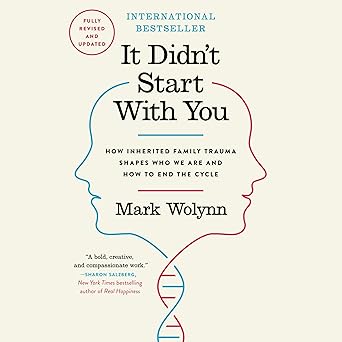


The Comprehensive Guide
Understanding inherited family trauma requires both the science and the practical framework. Here's the book that connects them together.
It Didn't Start with You: How Inherited Family Trauma Shapes Who We Are and How to End the Cycle
Mark Wolynn's international bestseller on how inherited family trauma shapes who we are. Drawing on emerging epigenetics research and family systems therapy, Wolynn offers a framework for identifying patterns that may originate in your family history and practical exercises for breaking the cycle. Includes family mapping tools, somatic awareness practices, and exercises for conscious healing of inherited wounds.
Honest transparency: this is an Amazon affiliate link. If you buy the book through it, we earn a tiny commission at no extra cost to you. But we only recommend books that connect back to the research and ideas in this article. Your local library almost certainly has this book too—and that's equally great.
References
- Yehuda, R., Daskalakis, N. P., Bierer, L. M., et al. (2016). Holocaust Exposure Induced Intergenerational Effects on FKBP5 Methylation. Biological Psychiatry, 80(5), 372–380. PubMed
- Yehuda, R. & Lehrner, A. (2018). Intergenerational transmission of trauma effects: putative role of epigenetic mechanisms. World Psychiatry, 17(3), 243–257. PMC6127768
- Watkeys, O. J., Queue, E., & Fedor, A. (2018). Glucocorticoid receptor gene (NR3C1) DNA methylation in association with trauma, psychopathology, transcript expression, or genotypic variation: A systematic review. Neuroscience & Biobehavioral Reviews, 90, 313–329.
- Epigenetic signatures of intergenerational exposure to violence in three generations of Syrian refugees. Scientific Reports (2025). Nature
- Impact of intergenerational trauma on second-generation descendants: a systematic review. BMC Psychology (2025). PMC12220155
- Parade, S. H., Gliga, T., Slade, L., et al. (2020). Harsh Parenting Predicts Novel HPA Receptor Gene Methylation and NR3C1 Methylation Predicts Cortisol Daily Slope in Middle Childhood. Cellular and Molecular Neurobiology.